worth a read.
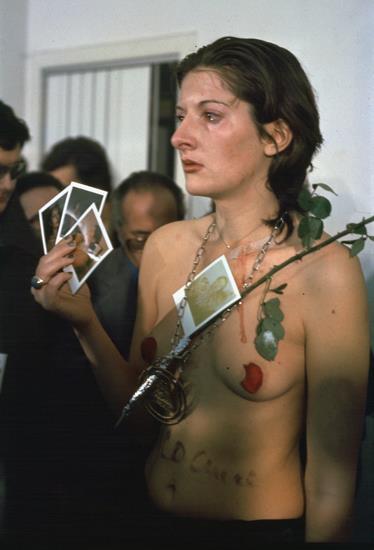
Marina Abramović, “Rhythm 0,” 1974
Marina Abramović is best known for her performance pieces, in which she tries to explore what is possible for an artist to do in the name of art. Her best known piece was the recent “The Artist Is Present,” in which she sat motionless for 736.5 hours over the course of three months, inviting visitors to sit opposite her and make eye contact for as long as they wanted. So many people began spontaneously crying across from her that blogs and Facebook groups were set up for those people.
Her bravest piece, however, is my favorite. This piece was primarily a trust exercise, in which she told viewers she would not move for six hours no matter what they did to her. She placed 72 objects one could use in pleasing or destructive ways, ranging from flowers and a feather boa to a knife and a loaded pistol, on a table near her and invited the viewers to use them on her however they wanted.
Initially, Abramović said, viewers were peaceful and timid, but it escalated to violence quickly. “The experience I learned was that … if you leave decision to the public, you can be killed… I felt really violated: they cut my clothes, stuck rose thorns in my stomach, one person aimed the gun at my head, and another took it away. It created an aggressive atmosphere. After exactly 6 hours, as planned, I stood up and started walking toward the public. Everyone ran away, escaping an actual confrontation.”
This piece revealed something terrible about humanity, similar to what Philip Zimbardo’s Stanford Prison Experiment or Stanley Milgram’s Obedience Experiment, both of which also proved how readily people will harm one another under unusual circumstances.
This performance showed just how easy it is to dehumanize a person who doesn’t fight back, and is particularly powerful because it defies what we think we know about ourselves. I’m certain the no one reading this believes the people around him/her capable of doing such things to another human being, but this performance proves otherwise.






















 Yutaki's Tumblr